Acoustic Tuning String Selector
© copyright: Joseph Jourdain, Josephus Harps, 2019
Overview
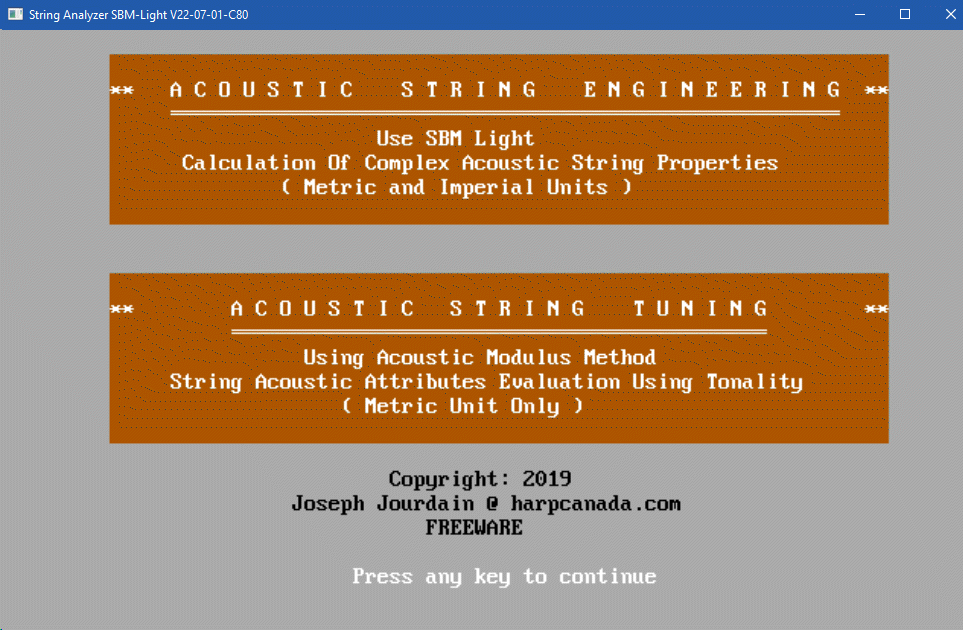
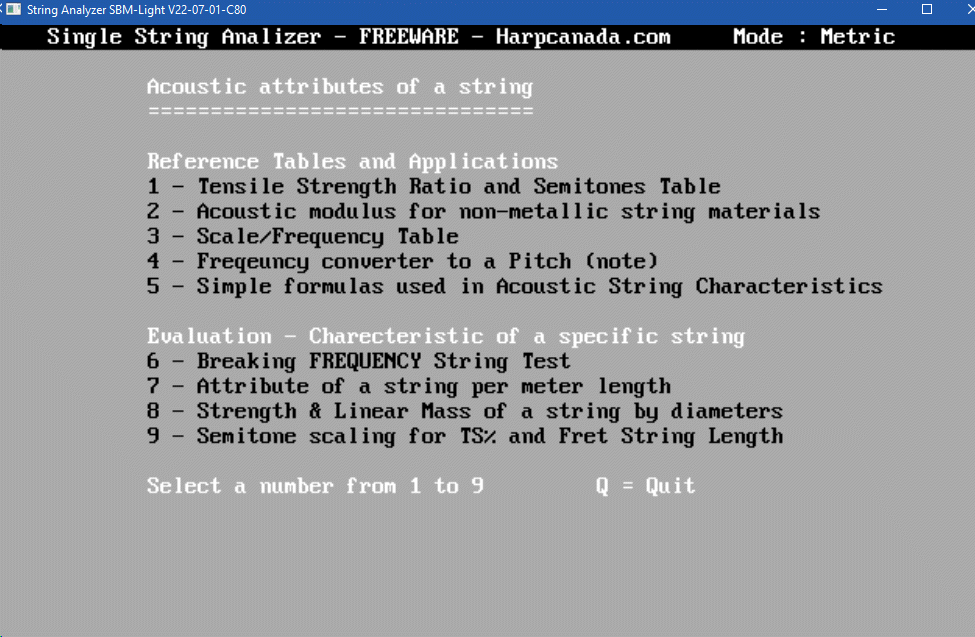
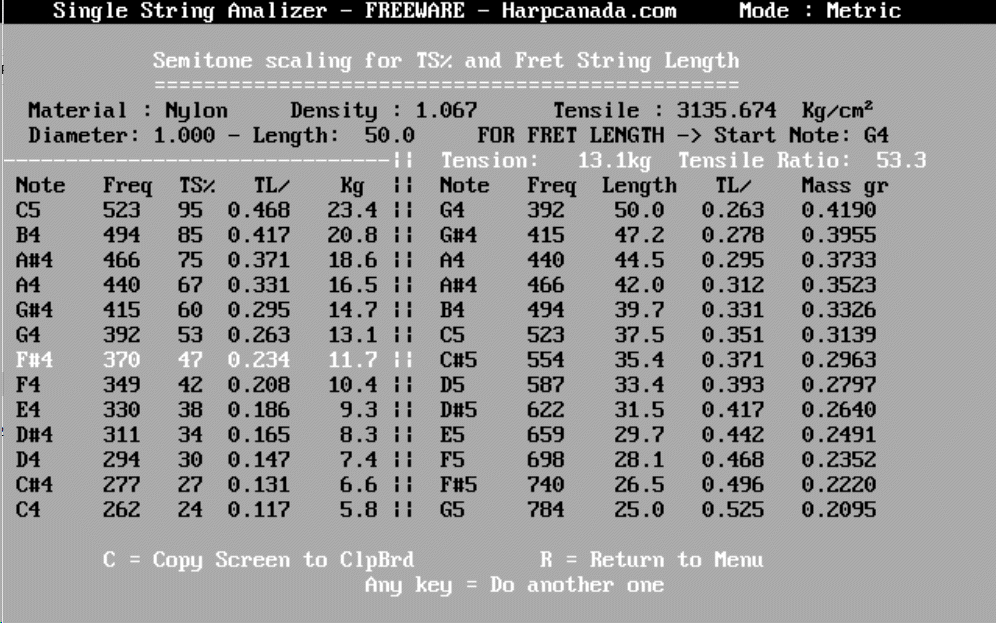
Acoustic Tuning app is a freeware you can download to compute string characteristic for harps and other stringed instruments. . It is compiled (using QB64) for running in Windows 64 bit. It is a calculator that does core string characteristics for single strings (one at a time). Only the metric unit system is used in this app. Results can only be saved to the clipboard as a screen shot. Below are three screen shots showing the opening screen, the calculation logarithms available, and one of the report displays from selection 9 on the menu. This one demonstrates the principles of the Acoustic Strength based on the Acoustic Modulus of a string as explored in the Stringing Inquiry page.
TECHNICAL INFORMATION:
Accuracy of calculation is 0.05% due to computer rounding of decimals. Numeric displays are to 3 decimal points, however the data saved and the computations are to 7 decimal points or more. When entering input value with more than 3 decimal points the computation is done with the full value but will be displayed to the third decimals.
Use the period (.) as the decimal place indicator and not the comma (,) as some countries do.
REFERENCE TO MATERIAL SELECTION:
MATERIAL CHARACTERISTICS USED IN THE PROGRAM:
Name:
Density
Lb/in2; Kg/cm2;
Nylon*
1.067
44600 3135.674
Fibre*
1.140
52000 3655.943
Gut
1.300
52000 3655.943
Steel
7.830
325000 22849.643
Bronze
8.870
125000 8788.324
Brass
8.437
110000 7733.725
Copper
8.930
61000 4288.702
Silver
10.474
41000 2882.570
Aluminum
2.700
20400 1434.255
The 2 Right columns refer to tensile strength.
* Nylon refers to Tynex from Dupont Corp. which is different from
nylon guitar strings.
* Fibre refers to synthetic silk (nylon)
- Steel refers to piano string
- For metals the value used should be checked to the sample you have,
values here are for pure or traditional alloys. Tensile strength for
silver and aluminum are theoretical.
User defined option for string material is available which allows you to use any material of your choice if you know the unique characteristic of that materrial. Units to be used for metric or Imperial units are as listed above.
The Material selection has a user defined material option where you can input your own material. You need to give a different name than the ones above, know its density and tensile strength. For wrap material the tensile strength reference is not used so it does not need to be accurate. Using "Redo this strings" in the report display will keep in menory the user defined material option for both core and wrap material for a different string setup with the same material. To reset the user defined option use the "Next String" option in the report display which will clear the menory and you will have to input the data for a new material.
BASIC STRINGING TUTORIAL
Most of the information you need to use for that application is accessible in the various menus. Reading the Stringing Inquiry page on this site is a must to really appreciate its functionality. The Breaking Frequency Test from #6 on the menu is a ready way to characterize any strings. Explore each menu item so you know where to get your references and how they can be used in your quest. The last item is really at the heart of the acoustic method where you will do your hard thinking.
The 3rd screen (menu #9) is the result from your inquiry for a 1mm diameter nylon string 50cm long. This is what Marin Mersenne understood, pitch is proportional to tension, string's length and diameter in different ways. Taylor refined those relationship with a greater mathematical accuracy for a perfectly flexible string.
The data on that screen tells you the highest note the string will make before it breaks, that is C5, with a tension at 23.4 Kg. As you lower the pitch by semitones the tension is reduced accordingly with a lower tensile strength ratio. At around 6 semitones lower than C5 the tensile strength ratio is around 50% and for that string, the tension is at about 12Kg. On the right side of the screen we see a fret length (string length) when the open string is tuned at G4 with at tensile strength ratio of about 53%. You can play with those variables and see how by changing string length, core diameter and note of the open string, you will affect the tonality of the string, all on one screen. This is at the core of string scalling and tonality for any instrument with a specific tuned resonator (sound board).
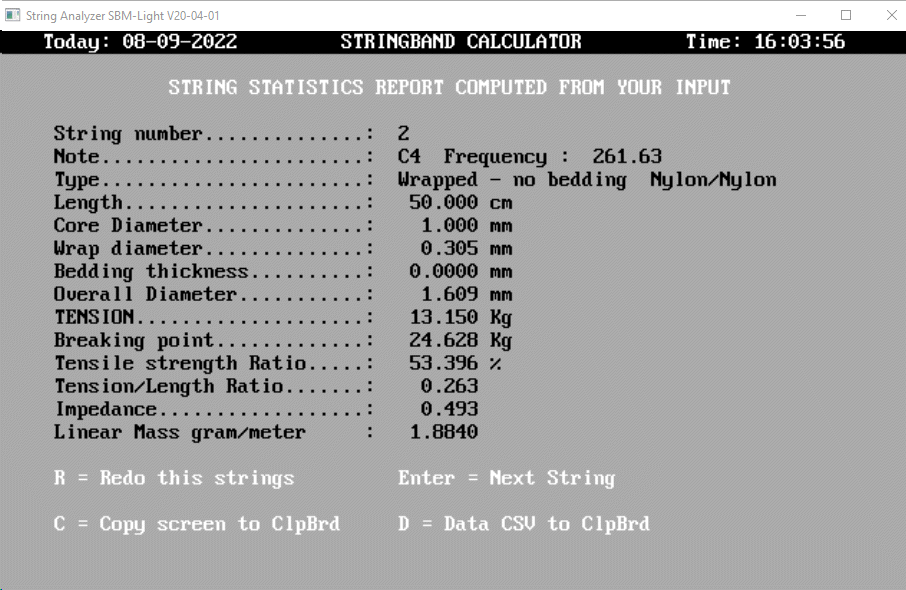
You can use the data on that screen to work out composite strings. Let us say you want to tune the above string to C4. The tension and the tensile strength ratio are too low for the strings to resonate. The string needs to be heavier so we can had a wrap to it, but how big should the wrap be? Now you can use SBM-light to do a wrap string calculation for the data you just got. Choose item 5 (find the wrap diameter of a wrapped string without bedding) on SBM-Light calculation menu and it calculates the wrap size you need from the tensile ratio I wanted (about 53% ) which is on the note G4 with a tension of about 13Kg and a T/L ratio of 0.263. For that calculation your input are core size, string length, note and T/L ratio which you got from the 3rd screen above. The wrap size calculated is 0.3mm. Now that you have the idealized value, you can redo the calculation with the wrap size stock you have access to. This scenario illustrates the flexibility of the Acoustic method for string selection.
You need to play with these ideas and your quest for fine tuning your strings will get easier. Reading the SBM-Light tutorial will help you to merge these 2 methods into a practical methodology. They compliment each other in a nice a more intuitive way.
If you came to this page from a search engine Click Here to see our entire website.